
• Skip to primary navigation
  • Skip to main content
  • Skip to primary sidebar

Corpus Christi Watershed

Pope Saint Paul VI (3 April 1969): “Although the text of the Roman Gradual—at least that which concerns the singing—has not been changed, the Entrance antiphons and Communions antiphons have been revised for Masses without singing.”

  • Donate
  • Our Team
    • Our Editorial Policy
    • Who We Are
    • How To Contact Us
    • Sainte Marie Bulletin Articles
    • Jeff’s Mom Joins Fundraiser
    • “Let the Choir Have a Voice” (Essay)
  • Pew Resources
    • Brébeuf Catholic Hymnal
    • Jogues Illuminated Missal
    • Repository • “Spanish Music”
    • KYRIALE • Saint Antoine Daniel
    • Campion Missal, 3rd Edition
  • MUSICAL WEBSITES
    • René Goupil Gregorian Chant
    • Noël Chabanel Psalms
    • Nova Organi Harmonia (2,279 pages)
    • Roman Missal, 3rd Edition
    • Catechism of Gregorian Rhythm
    • Father Enemond Massé Manuscripts
    • Lalemant Polyphonic
    • Feasts Website
  • Miscellaneous
    • Site Map
    • Secrets of the Conscientious Choirmaster
    • “Wedding March” for lazy organists
    • Emporium Kevin Allen
    • Saint Jean de Lalande Library
    • Sacred Music Symposium 2023
    • The Eight Gregorian Modes
    • Gradual by Pothier’s Protégé
    • Seven (7) Considerations
Views from the Choir Loft

Vesting Prayers • Part 6 of 9

Fr. David Friel · August 9, 2015

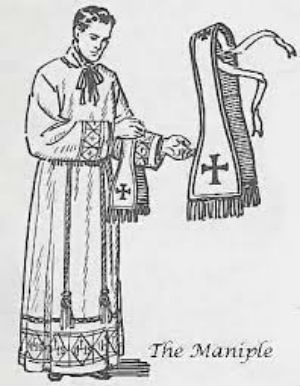
ANY CATHOLICS are totally unfamiliar with the maniple, inasmuch as they may never have seen one. So first, by way of description, the maniple is a piece of decorated cloth worn by the priest over his left arm. Coming into use by at least the 6th century, maniples vary widely in their shape, size, and ornamentation. In general form, a maniple looks like a mini stole with clasps or strings. Its use is neither required nor forbidden in the Ordinary Form, but it is required when the Extraordinary Form is offered.

The prayer that accompanies the vesting with the maniple is as follows (notice the rhyme):

Merear, Domine, portare manipulum fletus et doloris; ut cum exsultatione recipiam mercedem laboris.

May I deserve, O Lord, to bear the maniple of weeping and sorrow, in order that I may joyfully reap the reward of my labors.

It is fairly well accepted that the maniple originated as a sort of handkerchief (the Latin word mappula means “napkin”). Perhaps once practically used by the priest to wipe his brow, the maniple eventually took on a spiritual significance that is rather profound. (This is far from the only example of something practical taking on fuller meaning in the sacred liturgy.) The maniple, in time, came to be seen as symbolic of the toils of priestly life. This understanding is reflected in the beautifully honest vesting prayer, which pointedly acknowledges the weeping & sorrow that are part of every human life before it turns to focus on the reward of those labors.

In the background of this vesting prayer, we should also see the text of Psalm 126:

Those who sow in tears shall reap in joy.

Going they went and wept,

casting their seeds,

but coming they shall come with joyfulness,

carrying their maniples. (Vulgate: portantes manipulos suos)

Again, the maniple fell into disuse during the post-conciliar liturgical reforms (Sacred Congregation of Rites, Tres abhinc annos, #25). While it was never formally abrogated, it is customarily not worn in the Ordinary Form. In the Extraordinary Form, it remains a required vestment for the priest, deacon, and sub-deacon.

Wherever it is worn, let the maniple be a rich symbol of the great labor of love which is the priesthood.

Part 1 • Introduction

Part 2 • The Hand Washing

Part 3 • The Amice

Part 4 • The Alb

Part 5 • The Cincture

Part 6 • The Maniple

Part 7 • The Stole

Part 8 • The Chasuble

Part 9 • The Dalmatic

Opinions by blog authors do not necessarily represent the views of Corpus Christi Watershed.

Filed Under: Articles Tagged With: Traditional Catholic Vestments, Vesting Prayers Last Updated: March 29, 2021

Subscribe

It greatly helps us if you subscribe to our mailing list!

* indicates required

About Fr. David Friel

Ordained in 2011, Father Friel is a priest of the Archdiocese of Philadelphia and serves as Director of Liturgy at Saint Charles Borromeo Seminary. —(Read full biography).

Primary Sidebar

Corpus Christi Watershed

President’s Corner

    “Reminder” — Month of April (2026)
    On a daily basis, I speak to people who don’t realize we publish a free newsletter (although they’ve followed our blog for years). We have no endowment, no major donors, no savings, and refuse to run annoying ads. As a result, our mailing list is crucial to our survival. It couldn’t be easier to subscribe! Just scroll to the bottom of any blog article and enter your email address.
    —Jeff Ostrowski
    Simplified Accompaniment (Easter Hymn)
    Number 36 in the Brébeuf Hymnal is “At the Lamb’s high feast we sing,” an English translation for Ad Cenam Agni Próvidi (which was called “Ad Régias Agni Dapes” starting 1631). As of this morning, you can download a simplified keyboard accompaniment for it. Simply click here and scroll to the bottom. Many organists are forced to serve simultaneously as both CANTOR and ACCOMPANIST. In spite of what some claim, this can be difficult—which explains why choirmasters appreciate these simplified keyboard accompaniments. Sadly, many readers will click that link but forget to scroll to the bottom where the simplified PDF file is located.
    —Jeff Ostrowski
    PDF Download • “Quasi Modo Sunday”
    The Introit for “Quasi Modo Sunday” (12 April 2026) is particularly beautiful. The musical score can be downloaded as a PDF file, and so can the organ accompaniment. The official language of the Catholic Church is Latin (whereas Greek is our mother tongue). Vatican II said Gregorian Chant must be given “first place” under normal circumstances. As a result, some parishes will rightly sing the authentic version. On the other hand, because so many USA dioceses disobey the mandate of Vatican II, some musicians sing plainsong in the vernacular. I have attempted to simultaneously accompany myself on the pipe organ while singing the English version. Although very few take advantage of it, the complete Proprium Missae is posted at the flourishing feasts website.
    —Jeff Ostrowski

Quick Thoughts

    PDF Download • “Anima Christi”
    I received a request for an organ accompaniment I created way back in 2007 for the “Anima Christi” Gregorian Chant. You can download this PDF file which has the score in plainsong followed by a keyboard accompaniment. Many melodies have been paired with “Anima Christi” over the centuries, but this is—perhaps—the most common one.
    —Jeff Ostrowski
    PDF • “Liturgical Law” (467 Pages)
    On Good Friday during the middle ages, the pope privately recited THE ENTIRE PSALTER. If you don’t believe me, see for yourself by reading this passage by Dom Charles Augustine Bachofen (d. 1943). His famous book—called “Liturgical Law: A Handbook Of The Roman Liturgy”—was published by the Benjamin Herder Book Company, which was the American arm (operating out of St. Louis, Missouri) of one of the world’s most significant Catholic publishers. Dom Charles Augustine Bachofen was born in Switzerland but spent his career between the Benedictine monasteries at Conception (Missouri) and Mount Angel (Oregon). His 1931 masterpiece, Liturgical Law can be downloaded as a PDF file … 467 pages!
    —Jeff Ostrowski
    “Gregorian Chant Quiz” • 24 March 2026
    How well do you know your Gregorian hymns? Do you recognize the tune inserted into the bass line on this score? For many years, we sang the entire Mass in Gregorian chant—and I mean everything. As a result, it would be difficult to find a Gregorian hymn I don’t recognize instantly. Only decades later did I realize (with sadness) that this skill cannot be ‘monetized’… This particular melody is used for a very famous Gregorian hymn, printed in the LIBER USUALIS. Do you recognize it? Send me an email with the correct words, and I promise to tell everybody I meet about your prowess!
    —Jeff Ostrowski

Random Quote

What earlier generations held as sacred, remains sacred and great for us too, and it cannot be all of a sudden entirely forbidden or even considered harmful.

— ‘His Holiness, Pope Benedict XVI (7 July 2007)’

Recent Posts

  • “Reminder” — Month of April (2026)
  • “Gregorian Chant Isn’t a Platform for Your Personal Theories, Jeff” • (A Letter We Received)
  • Request From Australia
  • PDF Download • “Anima Christi”
  • PDF Download • “Rarer Than a Blue Moon” — Side-by-Side English Translation (Pius XII Psalter)

Subscribe

Subscribe

* indicates required

Copyright © 2026 Corpus Christi Watershed · Isaac Jogues on Genesis Framework · WordPress · Log in

Corpus Christi Watershed is a 501(c)3 public charity dedicated to exploring and embodying as our calling the relationship of religion, culture, and the arts. This non-profit organization employs the creative media in service of theology, the Church, and Christian culture for the enrichment and enjoyment of the public.