• Skip to primary navigation
  • Skip to main content
  • Skip to primary sidebar

Corpus Christi Watershed

Pope Saint Paul VI (3 April 1969): “Although the text of the Roman Gradual—at least that which concerns the singing—has not been changed, the Entrance antiphons and Communions antiphons have been revised for Masses without singing.”

  • Donate
  • Our Team
    • Our Editorial Policy
    • Who We Are
    • How To Contact Us
    • Sainte Marie Bulletin Articles
    • Jeff’s Mom Joins Fundraiser
  • Pew Resources
    • Brébeuf Catholic Hymnal
    • Jogues Illuminated Missal
    • Repository • “Spanish Music”
    • KYRIALE • Saint Antoine Daniel
    • Campion Missal, 3rd Edition
  • MUSICAL WEBSITES
    • René Goupil Gregorian Chant
    • Noël Chabanel Psalms
    • Nova Organi Harmonia (2,279 pages)
    • Roman Missal, 3rd Edition
    • Catechism of Gregorian Rhythm
    • Father Enemond Massé Manuscripts
    • Lalemant Polyphonic
    • Feasts Website
  • Miscellaneous
    • Site Map
    • Secrets of the Conscientious Choirmaster
    • “Wedding March” for lazy organists
    • Emporium Kevin Allen
    • Saint Jean de Lalande Library
    • Sacred Music Symposium 2023
    • The Eight Gregorian Modes
    • Gradual by Pothier’s Protégé
    • Seven (7) Considerations
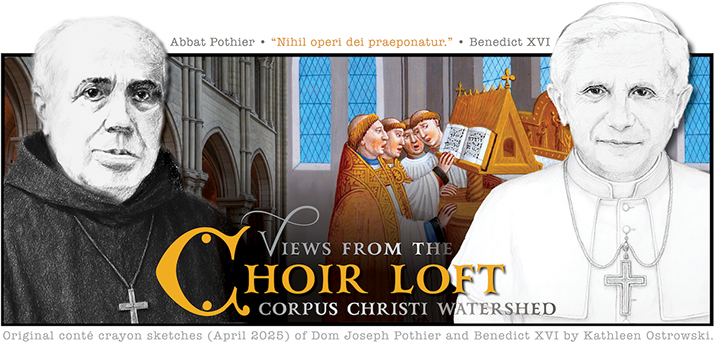
Views from the Choir Loft

Flor Peeters

Jeff Ostrowski · February 28, 2025

Re: “Abuse of Catholic Church Musicians”

Listening to yourself singing isn’t fun—but it’s crucial if you wish to improve.

Jeff Ostrowski · August 14, 2024

“Missa de Angelis” • Gloria

Feel free to download this PDF file containing GLORIA VIII (“Mass of the Angels”) harmonized by the great Belgian organist: Flor Peeters.

Jeff Ostrowski · May 16, 2023

PDF Download • César Franck Book of Gregorian Chant Accompaniments (156 Pages)

“The organ is so universally used as an accompanying instrument today that there is a pressing need to provide a written accompaniment…” —César Franck

Jeff Ostrowski · April 17, 2023

“I Came From Somewhere” • (So Did You!)

Including a haunting hymn by Flor Peeters for Eastertide.

Jeff Ostrowski · March 21, 2023

“Go!” • The Word That Changed My Life Forever

As Americans, we’re “bred from birth” to think of ourselves as little gods who already know everything and require no correction.

Jeff Ostrowski · March 9, 2023

PDF Download • Belgian “Ordinary of the Mass” (Organ Accompaniment) — 191 pages

This volume has been professionally scanned—and you’ll love the results!

Jeff Ostrowski · November 29, 2022

“Advent Hymn” • Composed by Flor Peeters

Peeters was organist at Malines Cathedral from 1923 until his death in 1986.

Jeff Ostrowski · September 13, 2022

PDF Download • 2-Voice Eucharistic Hymn by Flor Peeters (45 pages) • Includes a Descant!

Lyrics in English, with an (optional) version in Latin.

Corpus Christi Watershed · August 31, 2022

“This Hymnal Makes My Heart Sing!” —Lauren E.

“It was compiled by priests and musicians who are authentically Catholic…” — Lauren Elizabeth

Jeff Ostrowski · August 30, 2022

PDF Download • “Tantum Ergo” Two-Part Interlude (Manuals Only) by Flor Peeters

Including a stunningly gorgeous (and rare!) hymn by Flor Peeters.

Jeff Ostrowski · August 15, 2022

“Wild Accompaniment” • Flor Peeters (Kyrie VIII)

Kyrie “Missa de Angelis”—recorded yesterday by a volunteer choir.

Jeff Ostrowski · June 11, 2022

Composing Your Own Antiphons?

In the days before Vatican II, dioceses had their own special feast days.

Primary Sidebar

Corpus Christi Watershed

President’s Corner

    “Simplified” Keyboard Accompaniment (PDF)
    I’d much rather hear an organist play a simplified version correctly than listen to wrong notes. I invite you to download this simplified organ accompaniment for hymn #729 in the Father Brébeuf Hymnal. The hymn is “O Jesus Christ, Remember.” I’m toying with the idea of creating a whole bunch of these, to help amateur organists. The last one I uploaded was downloaded more than 1,900 times in a matter of hours—so there seems to be interest in such a project. For the record, this famous text by Oratorian priest, Father Edward Caswall (d. 1878) is often married to AURELIA, as it is in the Brébeuf Hymnal.
    —Jeff Ostrowski
    ‘Bogey’ of the Half-Educated: Paraphrase
    Father Adrian Porter, using the cracher dans la soupe example, did a praiseworthy job explaining the difference between ‘dynamic’ and ‘formal’ translation. This is something Monsignor Ronald Knox explained time and again—yet even now certain parties feign ignorance. I suppose there will always be people who pretend the only ‘valid’ translation of Mitigásti omnem iram tuam; avertísti ab ira indignatiónis tuæ… would be “You mitigated all ire of you; you have averted from your indignation’s ire.” Those who would defend such a translation suffer from an unfortunate malady. One of my professors called it “cognate on the brain.”
    —Jeff Ostrowski
    Father Cuthbert Lattey • “The Hebrew MSS”
    Father Cuthbert Lattey (d. 1954) wrote: “In a large number of cases the ancient Christian versions and some other ancient sources seem to have been based upon a better Hebrew text than that adopted by the rabbis for official use and alone suffered to survive. Sometimes, too, the cognate languages suggest a suitable meaning for which there is little or no support in the comparatively small amount of ancient Hebrew that has survived. The evidence of the metre is also at times so clear as of itself to furnish a strong argument; often it is confirmed by some other considerations. […] The Jewish copyists and their directors, however, seem to have lost the tradition of the metre at an early date, and the meticulous care of the rabbis in preserving their own official and traditional text (the ‘massoretic’ text) came too late, when the mischief had already been done.” • Msgr. Knox adds: “It seems the safest principle to follow the Latin—after all, St. Jerome will sometimes have had a better text than the Massoretes—except on the rare occasions when there is no sense to be extracted from the Vulgate at all.”
    —Jeff Ostrowski

Quick Thoughts

    “Reminder” — Month of November (2025)
    On a daily basis, I speak to people who don’t realize we publish a free newsletter (although they’ve followed our blog for years). We have no endowment, no major donors, no savings, and refuse to run annoying ads. As a result, our mailing list is crucial to our survival. Signing up couldn’t be easier: simply scroll to the bottom of any blog article and enter your email address.
    —Jeff Ostrowski
    Gospel Options for 2 November (“All Souls”)
    We’ve been told some bishops are suppressing the TLM because of “unity.” But is unity truly found in the MISSALE RECENS? For instance, on All Souls (2 November), any of these Gospel readings may be chosen, for any reason (or for no reason at all). The same is true of the Propria Missæ and other readings—there are countless options in the ORDINARY FORM. In other words, no matter which OF parish you attend on 2 November, you’ll almost certainly hear different propers and readings, to say nothing of different ‘styles’ of music. Where is the “unity” in all this? Indeed, the Second Vatican Council solemnly declared: “Even in the liturgy, the Church has no wish to impose a rigid uniformity in matters which do not implicate the faith or the good of the whole community.”
    —Corpus Christi Watershed
    “Our Father” • Musical Setting?
    Looking through a Roman Catholic Hymnal published in 1859 by Father Guido Maria Dreves (d. 1909), I stumbled upon this very beautiful tune (PDF file). I feel it would be absolutely perfect to set the “Our Father” in German to music. Thoughts?
    —Jeff Ostrowski

Random Quote

Giovanni Doni is known for having changed the name of note “Ut,” renaming it “Do.” He convinced his contemporaries to make the change by arguing that 1) “Do” is easier to pronounce than “Ut,” and 2) “Do” is an abbreviation for “Dominus,” the Latin word for the Lord, Who is the tonic and root of the world. There is much academic speculation that Giovanni Doni also wanted to imprint himself into musical canon in perpetuity because “Do” is also ulteriorly an abbreviation for his family name.

— Giovanni Battista Doni died in 1647AD

Recent Posts

  • PDF Download • “Pope Pius XII Psalter” — English, Latin, and Commentary (532 pages)
  • “Simplified” Keyboard Accompaniment (PDF)
  • ‘Bogey’ of the Half-Educated: Paraphrase
  • Father Cuthbert Lattey • “The Hebrew MSS”
  • Re: The People’s Mass Book (1974)

Subscribe

Subscribe

* indicates required

Copyright © 2025 Corpus Christi Watershed · Isaac Jogues on Genesis Framework · WordPress · Log in

Corpus Christi Watershed is a 501(c)3 public charity dedicated to exploring and embodying as our calling the relationship of religion, culture, and the arts. This non-profit organization employs the creative media in service of theology, the Church, and Christian culture for the enrichment and enjoyment of the public.