
• Skip to primary navigation
  • Skip to main content
  • Skip to primary sidebar

Corpus Christi Watershed

Pope Saint Paul VI (3 April 1969): “Although the text of the Roman Gradual—at least that which concerns the singing—has not been changed, the Entrance antiphons and Communions antiphons have been revised for Masses without singing.”

  • Donate
  • Our Team
    • Our Editorial Policy
    • Who We Are
    • How To Contact Us
    • Sainte Marie Bulletin Articles
    • Jeff’s Mom Joins Fundraiser
  • Pew Resources
    • Brébeuf Catholic Hymnal
    • Jogues Illuminated Missal
    • Repository • “Spanish Music”
    • KYRIALE • Saint Antoine Daniel
    • Campion Missal, 3rd Edition
  • MUSICAL WEBSITES
    • René Goupil Gregorian Chant
    • Noël Chabanel Psalms
    • Nova Organi Harmonia (2,279 pages)
    • Roman Missal, 3rd Edition
    • Catechism of Gregorian Rhythm
    • Father Enemond Massé Manuscripts
    • Lalemant Polyphonic
    • Feasts Website
  • Miscellaneous
    • Site Map
    • Secrets of the Conscientious Choirmaster
    • “Wedding March” for lazy organists
    • Emporium Kevin Allen
    • Saint Jean de Lalande Library
    • Sacred Music Symposium 2023
    • The Eight Gregorian Modes
    • Gradual by Pothier’s Protégé
    • Seven (7) Considerations
Views from the Choir Loft

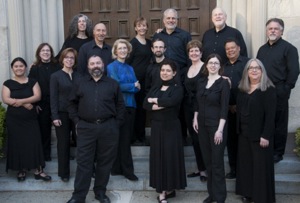
The Seraphim Singers • World Première of work by Adam Wood and Richard J. Clark

Richard J. Clark · October 23, 2015

HAVE LONG ADMIRED the writing of poet Adam Wood (b. 1982); his poetry, prose, and commentary are distinct, stemming in part from eclectic passions which include liturgy, theology, technology, economics and the Open Source. The results of such combination of interests are fascinating.

When Jennifer Lester, Director of The Seraphim Singers, asked me to compose another work for them on sacred poetry, I eagerly dug into Adam Wood’s work. His dedication to the spirit, art, and intellect (often infused with sharp wit) constitute a distinctly unique body of work from which one will elicit much inspiration and insight.

The result of this collaboration is On Emptiness, Wisdom, and Fortune (2014) which combines two of Wood’s poems On Fortune and On Emptiness. You can read Adam Wood’s essays and poems here.

IF YOU ARE IN THE BOSTON AREA be sure not to miss this premiere as part the Seraphim Singer’s “For Heaven Is a Different Thing.” Choral Settings of Sacred Poetry. There will be two performances:

Sunday, October 25, 2015, 3:00pm
First Church (Congregational) 11 Garden St., Cambridge, MA

Friday, October 30, 2015, 8:00pm
St. Cecilia Parish, 18 Belvidere St., Boston, MA

$20 general admission and $15 senior/student.
• Tickets are available at the door or purchase online here
• Download the concert program here
• Download the concert poster here


HE SERAPHIM SINGERS ARE ENORMOUS ADVOCATES of new music with several new commissions each year. Jennifer Lester’s programming is astonishingly vast, from Gregorian Chant and Renaissance Polyphony to Twenty-first Century works. Yet, her programming flows with astounding unity and beauty. The Boston Music Intelligencer writes:

“Ingenious programming by Jennifer Lester…”

“Anyone who cares about these genres owes it to him/herself to hear this gifted ensemble whenever possible.”

“Technically, the ensemble was in fine form, performing incredibly challenging choral repertoire with a high degree of finesse.”

Hope to see you there!

Opinions by blog authors do not necessarily represent the views of Corpus Christi Watershed.

Filed Under: Articles Last Updated: January 1, 2020

Subscribe

It greatly helps us if you subscribe to our mailing list!

* indicates required

About Richard J. Clark

Richard J. Clark is the Director of Music of the Archdiocese of Boston and the Cathedral of the Holy Cross.—(Read full biography).

Primary Sidebar

Corpus Christi Watershed

President’s Corner

    PDF • “Music List” (Immaculate Concep.)
    Readers have expressed interest in perusing the ORDER OF MUSIC I’ve prepared for 8 December 2025, the feast of OUR LADY’S IMMACULATE CONCEPTION. If such a thing interests you, feel free to download it as a PDF file. The fauxbourdon setting of the COMMUNION is exquisite. In Latin, the title of this feast is: In Conceptione Immaculata Beatae Mariae Virginis. As always, the Responsorial Psalm, Gospel Acclamation, and Mass Propers for this Sunday are available at the feasts website alongside the official texts in Latin.
    —Jeff Ostrowski
    “Reminder” — Month of December (2025)
    On a daily basis, I speak to people who don’t realize we publish a free newsletter (although they’ve followed our blog for years). We have no endowment, no major donors, no savings, and refuse to run annoying ads. As a result, our mailing list is crucial to our survival. Signing up couldn’t be easier: simply scroll to the bottom of any blog article and enter your email address.
    —Jeff Ostrowski
    Dr. Mahrt explains the ‘Spoken’ Propers
    In 1970, the Church promulgated a new version of the Roman Missal. It goes by various names: Ordinary Form, Novus Ordo, MISSALE RECENS, and so on. If you examine the very first page, you’ll notice that Pope Saint Paul VI explains the meaning of the ‘Spoken Propers’ (which are for Masses without singing). A quote by Dr. William P. Mahrt is also included in that file. The SPOKEN PROPERS—used at Masses without music—are sometimes called The Adalbert Propers, because they were created in 1969 by Father Adalbert Franquesa Garrós, one of Hannibal Bugnini’s closest friends (according to Yves Chiron). It would be difficult to phrase things more clearly than the pope: viz. the ADALBERT PROPERS are for recited Masses, the GRADUALE PROPERS are for Masses with singing.
    —Jeff Ostrowski

Quick Thoughts

    “Translations Approved for Liturgical Use”
    According to the newsletter for USSCB’s Committee on Divine Worship dated September 1996, there are three (3) translations of the Bible which can be used in the sacred liturgy in the United States. You can read this information with your own eyes. It seems the USCCB and also Rome fully approved the so-called NRSV (“New Revised Standard Version”) on 13 November 1991 and 6 April 1992 but this permission was then withdrawn in 1994.
    —Corpus Christi Watershed
    Gospel Options for 2 November (“All Souls”)
    We’ve been told some bishops are suppressing the TLM because of “unity.” But is unity truly found in the MISSALE RECENS? For instance, on All Souls (2 November), any of these Gospel readings may be chosen, for any reason (or for no reason at all). The same is true of the Propria Missæ and other readings—there are countless options in the ORDINARY FORM. In other words, no matter which OF parish you attend on 2 November, you’ll almost certainly hear different propers and readings, to say nothing of different ‘styles’ of music. Where is the “unity” in all this? Indeed, the Second Vatican Council solemnly declared: “Even in the liturgy, the Church has no wish to impose a rigid uniformity in matters which do not implicate the faith or the good of the whole community.”
    —Corpus Christi Watershed
    “Our Father” • Musical Setting?
    Looking through a Roman Catholic Hymnal published in 1859 by Father Guido Maria Dreves (d. 1909), I stumbled upon this very beautiful tune (PDF file). I feel it would be absolutely perfect to set the “Our Father” in German to music. Thoughts?
    —Jeff Ostrowski

Random Quote

At the Council of Trent, the subject was raised whether it was correct to refer to the unconsecrated elements of bread and wine as “immaculata hostia” (spotless victim) and “calix salutaris” (chalice of salvation) in the offertory prayers. Likewise the legitimacy of the making the sign of the cross over the elements after the Eucharistic consecration was discussed.

— ‘Fr. Uwe Michael Lang, Cong. Orat.’

Recent Posts

  • PDF • “Music List” (Immaculate Concep.)
  • PDF Downloads • 5 Simple Palestrina Pieces
  • Dr. Alfred Calabrese • “My Invitation To You”
  • “Reminder” — Month of December (2025)
  • PDF Download • Agnus Dei Polyphonic “Choral Extension” (Simple Round by Ravenscroft)

Subscribe

Subscribe

* indicates required

Copyright © 2025 Corpus Christi Watershed · Isaac Jogues on Genesis Framework · WordPress · Log in

Corpus Christi Watershed is a 501(c)3 public charity dedicated to exploring and embodying as our calling the relationship of religion, culture, and the arts. This non-profit organization employs the creative media in service of theology, the Church, and Christian culture for the enrichment and enjoyment of the public.