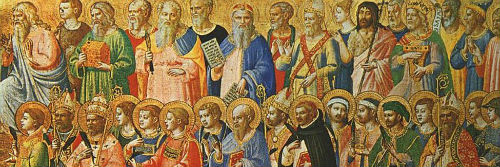
HIS WEEK, the Church celebrates two very important, related feasts. Last week, I reflected a bit on the second commemoration, All Souls’ Day; this week, my attention turns to the first of the two partner feasts, All Saints’ Day.
All Saints’ Day has long been my favorite celebration of the whole liturgical year. Perhaps my love for this feast began in third grade, when my classmates and I were allowed to dress up as a favorite saint that day and parade around through all of the classrooms at snack time (I was King David).
Over the years, my affinity for All Saints has deepened in direct correspondence to my increased awareness of humanity’s need for communion. The Christian life cannot be lived apart from community, although this community may admittedly take many forms. One very important form is that heavenly support of the Church Triumphant which buoys the Church Militant through the storms of earthly life.
The reality of the communion of saints is built into Catholic life, and it is expressed in all of our Sacraments. It is particularly evident in Baptism, Confirmation, and Holy Communion, and it is the fundamental basis for many of our devotions.
To be sure, the communion of saints is not ignored in the Ordinary Form of the Mass. Beyond the annual feast, the saints feature in a variety of prayers that may or must be used at every Mass. Yet, even stronger is the attention given to the saints by the Extraordinary Form of the Mass. One cannot go very long in the EF without encountering a saint.

Consider, then, the following list of all the moments during Mass in the Extraordinary Form when the Church calls upon the saints:
1. The Confiteor
Confíteor Deo omnipoténti, beátæ Maríæ semper Vírgini, beáto Michaéli Archángelo, beáto Joánni Baptístæ, sanctis Apóstolis Petro et Páulo, ómnibus Sanctis, et vobis, fratres, quia peccávi nimis cogitatióne, verbo, et ópere: mea culpa, mea culpa, mea máxima culpa. Ideo precor beátam Maríam semper Vírginem, beátum Michaélem Archángelum, beátum Joánnem Baptístam, sanctos Apóstolos Petrum et Páulum, omnes Sanctos, et vos, fratres, oráre pro me ad Dóminum Deum nostrum.The Confiteor is prayed a second time, by the servers. In some places, it is prayed yet again before the communion of the faithful.
2. The Oramus te, Domine
Orámus te, Dómine, per mérita Sanctórum tuórum, quorum relíquiae hic sunt, et ómnium Sanctórum: ut indulgére dignéris ómnia peccáta mea. Amen.3. The Collect(s)
Often, a saint is named in the collect, and the EF allows for the commemoration of multiple saints at a single Mass.4. The Munda cor meum
Munda cor meum, ac labia mea, omnípotens Deus, qui labia Isaíæ Prophétæ cálculo mundásti igníto: ita me tua grata miseratióne dignáre mundáre, ut sanctum Evangélium tuum digne váleam nuntiáre. Per Christum, Dóminum nostrum. Amen.5. The Credo
Credo in unum Deum, Patrem omnipoténtem, factórem coeli et terræ, visibílium ómnium et in visibílium. Et in unum Dóminum Iesum Christum, Fílium Dei unigénitum. Et ex Patre natum ante ómnia saecula. Deum de Deo, lumen de lúmine, Deum verum de Deo vero. Génitum, non factum, consubstantiálem Patri: per quem ómnia facta sunt. Qui propter nos hómines et propter nostram salútem descéndit de coelis. Et incarnátus est de Spíritu Sancto ex María Vírgine: Et homo factus est. Crucifíxus étiam pro nobis: sub Póntio Piláto passus, et sepúltus est. Et resurréxit tértia die, secúndum Scriptúras. Et ascéndit in coelum: sedet ad déxteram Patris. Et íterum ventúrus est cum glória iudicáre vivos et mórtuos: cuius regni non erit finis. Et in Spíritum Sanctum, Dóminum et vivificántem: qui ex Patre Filióque procédit. Qui cum Patre et Fílio simul adorátur et conglorificátur: qui locútus est per Prophétas. Et unam sanctam cathólicam et apostólicam Ecclésiam. Confíteor unum baptísma in remissiónem peccatórum. Et exspécto resurrectiónem mortuórum. Et vitam ventúri saeculi. Amen.6. The Offering of the Bread
Suscipe, sancte Pater, omnipotens ætérne Deus, hanc immaculátam hóstiam, quam ego indígnus fámulus tuus óffero tibi Deo meo vivo et vero, pro innumerabílibus peccátis, et offensiónibus, et neglegéntiis meis, et pro ómnibus circumstántibus, sed et pro ómnibus fidélibus christiánis vivis atque defúnctis: ut mihi, et illis profíciat ad salútem in vitam ætérnam. Amen.7. The Blessing of Incense at the Offertory
Per intercessiónem beáti Michaélis Archángeli, stantis a dextris altáris incénsi, et ómnium electórum suórum, incénsum istud dignétur Dóminus benedícere, et in odórem suavitátis accípere. Per Christum Dóminum nostrum. Amen.8. The Suscipe, sancta Trinitas
Súscipe, sancta Trinitas, hanc oblatiónem, quam tibi offérimus ob memóriam passiónis, resurrectiónis, et ascensiónis Iesu Christi, Dómini nostri: et in honórem beátæ Maríæ semper Vírginis, et beáti Ioannis Baptistæ, et sanctórum Apostolórum Petri et Pauli, et istórum et ómnium Sanctórum: ut illis profíciat ad honórem, nobis autem ad salútem: et illi pro nobis intercédere dignéntur in coelis, quorum memóriam ágimus in terris. Per eúndem Christum, Dóminum nostrum. Amen.9. The Preface
The common preface concludes in this way:Per quem maiestátem tuam laudant Angeli, adórant Dominatiónes, tremunt Potestátes. Cæli cælorúmque Virtútes ac beáta Séraphim sócia exultatióne concelebrant. Cum quibus et nostras voces ut admítti iúbeas, deprecámur, súpplici confessióne dicéntes: Sanctus, Sanctus, Sanctus…
10. The Canon
Numerous allusions to the saints are made during the Roman Canon. They include:Communicántes, et memóriam venerántes, in primis gloriósæ semper Vírginis Maríæ, Genetrícis Dei et Dómini nostri Iesu Christi: sed et beati Ioseph, eiusdem Virginis Sponsi,
et beatórum Apostolórum ac Mártyrum tuórum, Petri et Pauli, Andréæ, Iacóbi, Ioánnis, Thomæ, Iacóbi, Philíppi, Bartholomaei, Matthaei, Simónis et Thaddaei: Lini, Cleti, Cleméntis, Xysti, Cornélii, Cypriáni, Lauréntii, Chrysógoni, Ioánnis et Pauli, Cosmæ et Damiáni: et ómnium Sanctórum tuórum; quorum méritis precibúsque concédas, ut in ómnibus protectiónis tuæ muniámur auxílio. Per eúndem Christum, Dóminum nostrum. Amen.Hanc igitur oblatiónem servitutis nostræ, sed et cunctae famíliæ tuæ, quaesumus, Dómine, ut placátus accípias: diésque nostros in tua pace dispónas, atque ab ætérna damnatióne nos éripi, et in electórum tuórum iúbeas grege numerári. Per Christum, Dóminum nostrum. Amen.
Unde et mémores, Dómine, nos servi tui, sed et plebs tua sancta, eiusdem Christi Fílii tui, Dómini nostri, tam beátæ passiónis, nec non et ab ínferis resurrectiónis, sed et in coelos gloriósæ ascensiónis: offérimus præcláræ maiestáti tuæ de tuis donis ac datis, hóstiam puram, hóstiam sanctam, hóstiam immaculátam, Panem sanctum vitæ ætérnæ, et Calicem salútis perpétuæ.
Nobis quoque peccatóribus fámulis tuis, de multitúdine miseratiónum tuárum sperántibus, partem áliquam et societátem donáre dignéris, cum tuis sanctis Apóstolis et Martýribus: cum Ioánne, Stéphano, Matthía, Bárnaba, Ignátio, Alexándro, Marcellíno, Petro, Felicitáte, Perpétua, Agatha, Lúcia, Agnéte, Cæcília, Anastásia, et ómnibus Sanctis tuis: intra quorum nos consortium, non æstimátor mériti, sed véniæ, quaesumus, largítor admítte. Per Christum, Dóminum nostrum.
11. The Libera nos, quæsumus
Líbera nos, quaesumus, Dómine, ab ómnibus malis, prætéritis, præséntibus et futúris: et intercedénte beáta et gloriósa semper Vírgine Dei Genetríce María, cum beátis Apóstolis tuis Petro et Paulo, atque Andréa, et ómnibus Sanctis, da propítius pacem in diébus nostris: ut, ope misericórdiæ tuæ adiúti, et a peccáto simus semper líberi et ab omni perturbatióne secúri. Per eúndem Dóminum nostrum Iesum Christum, Fílium tuum, qui tecum vivit et regnat in unitáte Spíritus Sancti Deus, per omnia saecula saeculorum. Amen.12. The Last Gospel
In princípio erat Verbum, et Verbum erat apud Deum, et Deus erat Verbum. Hoc erat in princípio apud Deum. Omnia per ipsum facta sunt: et sine ipso factum est nihil, quod factum est: in ipso vita erat, et vita erat lux hóminum: et lux in ténebris lucet, et ténebræ eam non comprehendérunt. Fuit homo missus a Deo, cui nomen erat Ioánnes. Hic venit in testimónium, ut testimónium perhibéret de lúmine, ut omnes créderent per illum. Non erat ille lux, sed ut testimónium perhibéret de lúmine. Erat lux vera, quæ illúminat omnem hóminem veniéntem in hunc mundum. In mundo erat, et mundus per ipsum factus est, et mundus eum non cognóvit. In própria venit, et sui eum non recepérunt. Quotquot autem recepérunt eum, dedit eis potestátem fílios Dei fíeri, his, qui credunt in nómine eius: qui non ex sanguínibus, neque ex voluntáte carnis, neque ex voluntáte viri, sed ex Deo nati sunt. Et Verbum caro factum est, et habitávit in nobis: et vídimus glóriam eius, glóriam quasi Unigéniti a Patre, plenum grátiæ et veritatis. Deo gratias.
The repeated reference to the communion of saints in the Extraordinary Form of the Roman Rite becomes, in a certain sense, an incantation—a litany of saints in a different form than that to which we are accustomed.
This continual reminder of the saints’ presence has never appeared to me to be a “useless repetition” (cf. Sacrosanctum Concilium, #34). Nor has it yet ceased to encourage and console me.