
• Skip to primary navigation
  • Skip to main content
  • Skip to primary sidebar

Corpus Christi Watershed

Pope Saint Paul VI (3 April 1969): “Although the text of the Roman Gradual—at least that which concerns the singing—has not been changed, the Entrance antiphons and Communions antiphons have been revised for Masses without singing.”

  • Donate
  • Our Team
    • Our Editorial Policy
    • Who We Are
    • How To Contact Us
    • Sainte Marie Bulletin Articles
    • Jeff’s Mom Joins Fundraiser
    • “Let the Choir Have a Voice” (Essay)
  • Pew Resources
    • Brébeuf Catholic Hymnal
    • Jogues Illuminated Missal
    • Repository • “Spanish Music”
    • KYRIALE • Saint Antoine Daniel
    • Campion Missal, 3rd Edition
  • MUSICAL WEBSITES
    • René Goupil Gregorian Chant
    • Noël Chabanel Psalms
    • Nova Organi Harmonia (2,279 pages)
    • Roman Missal, 3rd Edition
    • Catechism of Gregorian Rhythm
    • Father Enemond Massé Manuscripts
    • Lalemant Polyphonic
    • Feasts Website
  • Miscellaneous
    • Site Map
    • Secrets of the Conscientious Choirmaster
    • “Wedding March” for lazy organists
    • Emporium Kevin Allen
    • Saint Jean de Lalande Library
    • Sacred Music Symposium 2023
    • The Eight Gregorian Modes
    • Gradual by Pothier’s Protégé
    • Seven (7) Considerations
Views from the Choir Loft

The Frontier of Liturgical Composition

Richard J. Clark · July 1, 2016

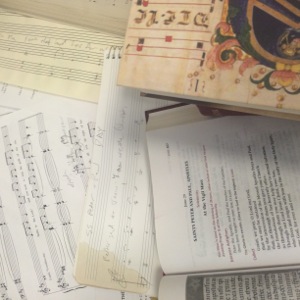
Y DESK IS A mess—a veritable disaster. Once every few months, whether it needs it or not, I clear off and reorganize my desk. I can then remember what color it is. I usually find a few old drafts of compositions. However, my filing system is highly efficient. Everything’s out.

Germane to the discussion of my working environment: Last week, Veronica Brandt wrote a brilliant article: It’s not about talent. She hits home her point here: “In short, talent just doesn’t come into it. The thing that makes music happen is lots and lots of work.” Very few see the work behind the final product. Some make it look easy, but it never is. The work is a form of service. Talent without work leads to artistic and personal atrophy. One may never blossom into the mature artist on talent alone. Hard work sometimes over the course of decade, is the only way to make a small difference in the world.

Understanding that our work is service to God, the liturgy, and to humanity, composition is a form of service, especially if approached in a certain way. While it is important to develop one’s own voice, the function of a work is primary. Self-glorification cancels out a true sense of purpose. Today, this true purpose is to help the faithful pray the words of the Mass, and not to be a form of personal self-expression. This may be a dangerous frontier, to be certain. But in the end, we will find God at our center.

ORE THAN FIFTY YEARS after the Second Vatican Council, the frontier of composition is clearly producing new settings of the propers in the vernacular, useful for a typical parish. This is not unlike the time immediately after the Second Vatican Council. The frontier of liturgical composition then was the need for settings in the vernacular to be sung by a congregation. In the United States, this elicited results in the 1970s ranging from the St. Louis Jesuits to Theodore Marier. Then what was the frontier became the norm.

But now, many of us are aware of the awakening of “singing the Mass” rather than “singing at Mass.” Many, many composers have tackled the propers. As such, singing the propers—an integral part of singing the Mass—is slowly making its way into the mainstream.

Dr. Jerry Galipeau, Vice President and Chief Publishing Officer at J. S. Paluch Company and World Library Publications, recently wrote in his blog Gotta Sing Gotta Pray:

”…the introduction of the proper communion antiphons is still a work in progress. I believe it takes years for this practice to really become a part of the music at Mass. This was a great example of “singing the Mass,” rather than “singing at Mass.”

While I have been working on Communion propers for the entire year (more to come out soon with WLP) my desk is a colossal mess because of all my reference books to do this work. Others did the work before me: recent publications from Adam Bartlett, Richard Rice especially are constant reference materials. The publications from Solesmes have been a constant companion.

The work is also a form of prayer. Meditate on the Antiphons and type in every work of the psalm verses and you cannot help but be transformed. Obsess and constantly revise harmonizations and stay awake longer at night to make a tiny contribution that might be useful to some modest parish somewhere? I hope it is prayer. I hope it is of service to some. But service is what God asks of us every single day of our lives.

Soli Deo gloria

Opinions by blog authors do not necessarily represent the views of Corpus Christi Watershed.

Filed Under: Articles Last Updated: January 1, 2020

Subscribe

It greatly helps us if you subscribe to our mailing list!

* indicates required

About Richard J. Clark

Richard J. Clark is the Director of Music of the Archdiocese of Boston and the Cathedral of the Holy Cross.—(Read full biography).

Primary Sidebar

Corpus Christi Watershed

President’s Corner

    Music List • (2nd Sunday of Lent)
    Readers have expressed interest in seeing the ORDER OF MUSIC I created for this coming Sunday—1 March 2026—the 2nd Sunday of Lent (Year A). If such a thing interests you, feel free to download it as a PDF file. As always, the Responsorial Psalm, Gospel Acclamation, and Mass Propers for this Sunday are available at the flourishing feasts website alongside the official texts in Latin.
    —Jeff Ostrowski
    Particularly Beautiful
    The 2nd Sunday of Lent has magnificent propers. Its INTROIT is particularly striking—using a haunting tonality—but the COMMUNION with fauxbourdon verses is also quite remarkable. I encourage all the readers to visit the feasts website, where the Propria Missae may be downloaded completely free of charge.
    —Jeff Ostrowski
    Which Mass?
    In 1905, when the Vatican Commission on Gregorian Chant began publishing the EDITIO VATICANA—still the Church’s official edition— they assigned different Masses to different types of feasts. However, they were careful to add a note (which began with the words “Qualislibet cantus hujus Ordinarii…”) making clear “chants from one Mass may be used together with those from others.” Sadly, I sometimes worked for TLM priests who weren’t fluent in Latin. As a result, they stubbornly insisted Mass settings were ‘assigned’ to different feasts and seasons (which is false). To understand the great variety, one should examine the 1904 KYRIALE of Dr. Peter Wagner. One should also look through Dom Mocquereau’s Liber Usualis (1904), in which the Masses are all mixed up. For instance, Gloria II in his book ended up being moved to the ‘ad libitum’ appendix in the EDITIO VATICANA.
    —Jeff Ostrowski

Quick Thoughts

    Extreme Unction
    Those who search Google for “CCCC MS 079” will discover high resolution images of a medieval Pontificale (“Cambridge, Corpus Christi College, MS 079”). One of the pages contains this absolutely gorgeous depiction of the Sacrament of Extreme Unction.
    —Corpus Christi Watershed
    PDF Chart • “Plainsong Rhythm”
    I will go to my grave without understanding the lack of curiosity so many people have about the rhythmic modifications made by Dom André Mocquereau. For example, how can someone examine this single sheet comparison chart and at a minimum not be curious about the differences? Dom Mocquereau basically creates a LONG-SHORT LONG-SHORT rhythmic pattern—in spite of enormous and overwhelming manuscript evidence to the contrary. That’s why some scholars referred to his method as “Neo-Mensuralist” or “Neo-Mensuralism.”
    —Jeff Ostrowski
    PDF • “O Come All Ye Faithful” (Simplified)
    I admire the harmonization of “Adeste Fideles” by David Willcocks (d. 2015), who served as director of the Royal College of Music (London, England). In 2025, I was challenged to create a simplified arrangement for organists incapable of playing the authentic version at tempo. The result was this simplified keyboard arrangement (PDF download) based on the David Willcocks version of “O Come All Ye Faithful.” Feel free to play through it and let me know what you think.
    —Jeff Ostrowski

Random Quote

“Although some may not understand what is being sung, they understand why it is being sung, that is, for the praise of God, and this is enough, even if the faithful do not strictly speaking sing in order to rouse their devotion.”

— Saint Thomas Aquinas

Recent Posts

  • Music List • (2nd Sunday of Lent)
  • Particularly Beautiful
  • PDF Download • “Funerals in the Ordinary Form”
  • Extreme Unction
  • Which Mass?

Subscribe

Subscribe

* indicates required

Copyright © 2026 Corpus Christi Watershed · Isaac Jogues on Genesis Framework · WordPress · Log in

Corpus Christi Watershed is a 501(c)3 public charity dedicated to exploring and embodying as our calling the relationship of religion, culture, and the arts. This non-profit organization employs the creative media in service of theology, the Church, and Christian culture for the enrichment and enjoyment of the public.